
Durham Homelessness System
Client Journey: Lowest-Barrier Single Adult
Where clients drop off, get stuck, and what works.
Download the PDFThis is the map that came out of the workshop. Participants told us the original six-phase baseline was too linear and too tidy — so this version adds two phases, renames others, and marks the places where people actually fall out of the system. The full narrative behind it is in the Narrative Summary & Critique.
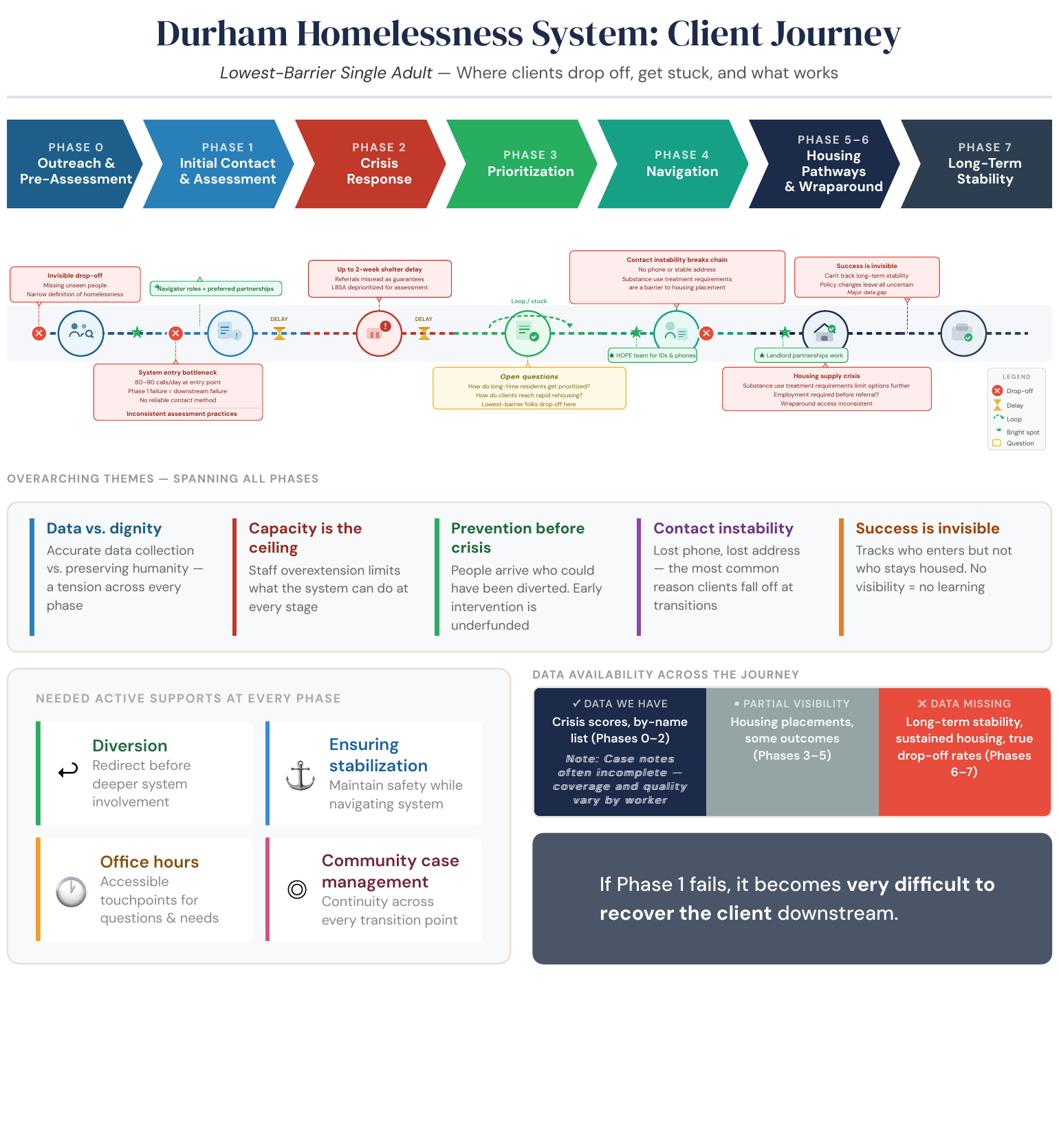
The eight phases
| Phase | Name |
|---|---|
| 0 | Outreach & pre-assessment |
| 1 | Initial contact & assessment |
| 2 | Crisis response |
| 3 | Prioritization |
| 4 | Navigation |
| 5–6 | Housing pathways & wraparound |
| 7 | Long-term stability |
Where the journey breaks
- Invisible drop-off — Missing unseen people; a narrow definition of homelessness.
- System entry bottleneck — 80–90 calls a day at the entry point, no reliable contact method, and inconsistent assessment practices.
- Up to a two-week shelter delay — Referrals misread as guarantees; lowest-barrier single adults deprioritized at assessment.
- Contact instability breaks the chain — No phone or stable address; substance use treatment requirements act as a barrier to housing placement.
- Housing supply crisis — Treatment requirements limit options further; wraparound access is inconsistent.
- Success is invisible — We can’t track long-term stability. A major data gap.
What works
- Navigator roles and preferred partnerships.
- The HOPE Team for IDs and phones.
- Landlord partnerships.
Open questions
- How do long-time residents get prioritized?
- How do clients reach rapid rehousing?
- Is employment required before referral?
Themes that span every phase
| Theme | What it means |
|---|---|
| Data vs. dignity | Accurate data collection vs. preserving humanity — a tension across every phase. |
| Capacity is the ceiling | Staff overextension limits what the system can do at every stage. |
| Prevention before crisis | People arrive who could have been diverted. Early intervention is underfunded. |
| Contact instability | Lost phone, lost address — the most common reason clients fall off at transitions. |
| Success is invisible | The system tracks who enters but not who stays housed. No visibility means no learning. |
Supports needed at every phase
- Diversion — Redirect before deeper system involvement.
- Ensuring stabilization — Maintain safety while navigating the system.
- Office hours — Accessible touchpoints for questions and needs.
- Community case management — Continuity across every transition point.
What we can and can’t see
| Visibility | What the data covers |
|---|---|
| Data we have | Crisis scores, by-name list (Phases 0–2) |
| Partial visibility | Housing placements, some outcomes (Phases 3–5) |
| Data missing | Long-term stability, sustained housing, true drop-off rates (Phases 6–7) |
Case notes are often incomplete — coverage and quality vary by worker.
If Phase 1 fails, it becomes very difficult to recover the client downstream.