
Briefs · Durham Strategic Framework
The Flexible Housing Assistance Fund
Funding that moves at the speed of the work.
Download the PDFWhy It Matters
Households exit homelessness in moments — when a landlord says yes, when an arrears amount gets cleared, when a security deposit lands on time. If money can’t move at the speed of those moments, the moments pass. The Flexible Housing Assistance Fund is the financial infrastructure that lets Durham’s system act when opportunity opens. In the February 2026 family sprint, that speed was the difference — application fees, arrears, and deposits moved when the deals did, and fifteen families were home within a month. Just as importantly: it fills a critical funding gap for between 600-700 unsheltered people in Durham who face financial barriers to enter housing.
The Approach
Durham will consolidate housing payment functions related to flexible housing funds into a single, centralized fiscal agent that can issue payments within one business day, manage HAP contracts at scale, and underwrite the risk-mitigation guarantees that make landlord engagement credible. The premise is a pre-approved menu of allowable costs, minimal documentation friction, and one place every case manager in the system sends a request for flexible housing assistance funds.
Key Elements
- Centralized fiscal administration. A single entity receives, manages, and disburses flexible housing assistance funds across all programs in the system, eliminating duplication and giving every provider one familiar workflow.
- A pre-approved menu of allowable costs. Examples include application fees, arrears, holding fees, security deposits, landlord incentives, moving expenses, utility deposits and payments, rental assistance, hotel placements when no shelter is available, renter’s insurance, and risk-mitigation reserves.
- Speed standards. Funds disbursed within one business day of complete documentation. Utility payments aligned to landlord billing cycles. No late fees absorbed by participants.
- Rental assistance via HAP contracts. Direct deposit to landlords on the 1st of each month, with tenants contributing income-adjusted portions and a progressive payment model designed to transfer full rent responsibility to the household within 12 months.
- Risk-mitigation reserves. Up to two months’ rent in documented damage coverage, with the unit made available to another household exiting homelessness if mitigation funds are used.
- Single point of entry. Referrals come exclusively from the Coordinated Entry Administrator, ensuring equitable access and alignment with the by-name list.
Why speed and funds matter
When money moves at the speed of opportunity, more people get housed. A case manager who finds a unit on Tuesday doesn’t have to choose between losing it and waiting on a Thursday committee. The pre-approved menu, the single submission process, and the one-business-day standard reduce the system’s reaction time to match the urgency of an unhoused household’s situation. More critically: the very existence of flexible housing assistance funds will open doors for people to whom housing options are currently locked.
How this fits in the system
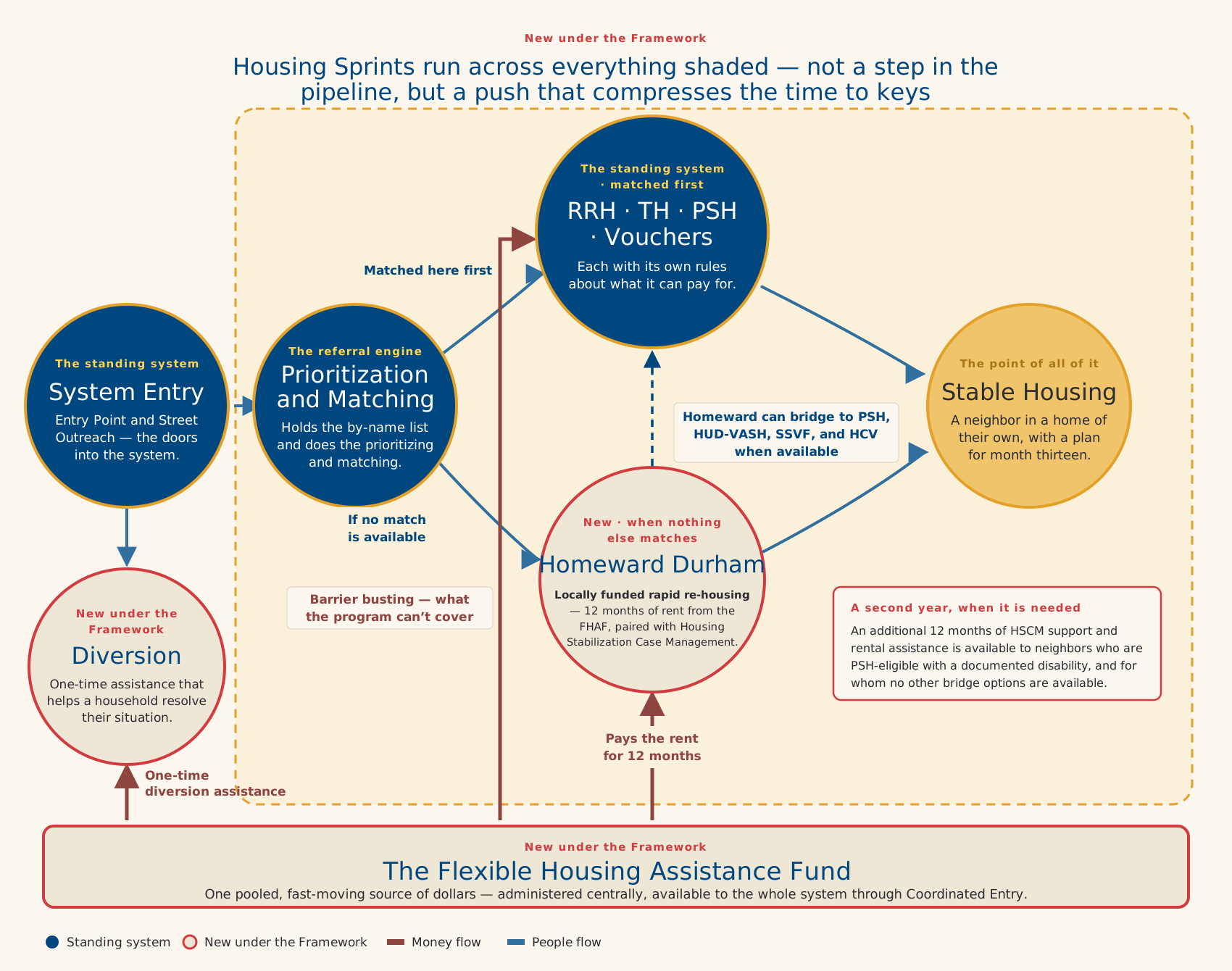
The Fund is not a program; it is the money layer underneath several programs at once, which is why it shows up in more than one place. The diagram below separates two flows that are easy to conflate: how people move through the system, and what the Fund pays for.
Reading the diagram
People flow · navy
- One front door. Coordinated Entry holds the by-name list and does the prioritizing and matching.
- Matched to the standing system first. Prioritization and matching sends households into RRH, transitional housing, PSH, and vouchers first; Homeward Durham is where a household lands when nothing else matches.
- Homeward Durham can bridge. Twelve months of locally funded rapid re-housing, with a further twelve available to neighbors who are PSH-eligible with a documented disability and have no other bridge open to them. From there a household can move to PSH, HUD-VASH, SSVF, or an HCV when one becomes available.
The accelerant · gold
- Sprints are not a stop on the line. The shaded span on the diagram is what a sprint acts across: a time-bound, all-hands push concentrating the whole system on a prioritized cohort.
- Program-agnostic. Anyone on the list can be in a sprint, whatever program they are matched to. Selection follows Coordinated Entry prioritization, nothing else.
- What it changes is time. The journey is the same; a sprint compresses the distance from prioritization to keys.
Money flow · clay
- Rental assistance. The Fund pays Homeward Durham’s twelve months of rent.
- Barrier busting. Where RRH, PSH, or a voucher cannot cover a cost between a household and a unit, the Fund can.
- Diversion. One-time assistance at the front door — System Entry can route a household to the Fund to resolve their situation without needing further assistance from the homelessness system.