
Briefs · Durham Strategic Framework
Encampment Response Pathways
How Durham responds when an encampment is reported — and the three pathways when a site can no longer remain.
Download the PDFEvery encampment response begins the same way: our street outreach team goes to the site, meets the people living there, and offers support. What happens when a site can no longer remain depends on a single question — who owns the land.
Response starts with outreach
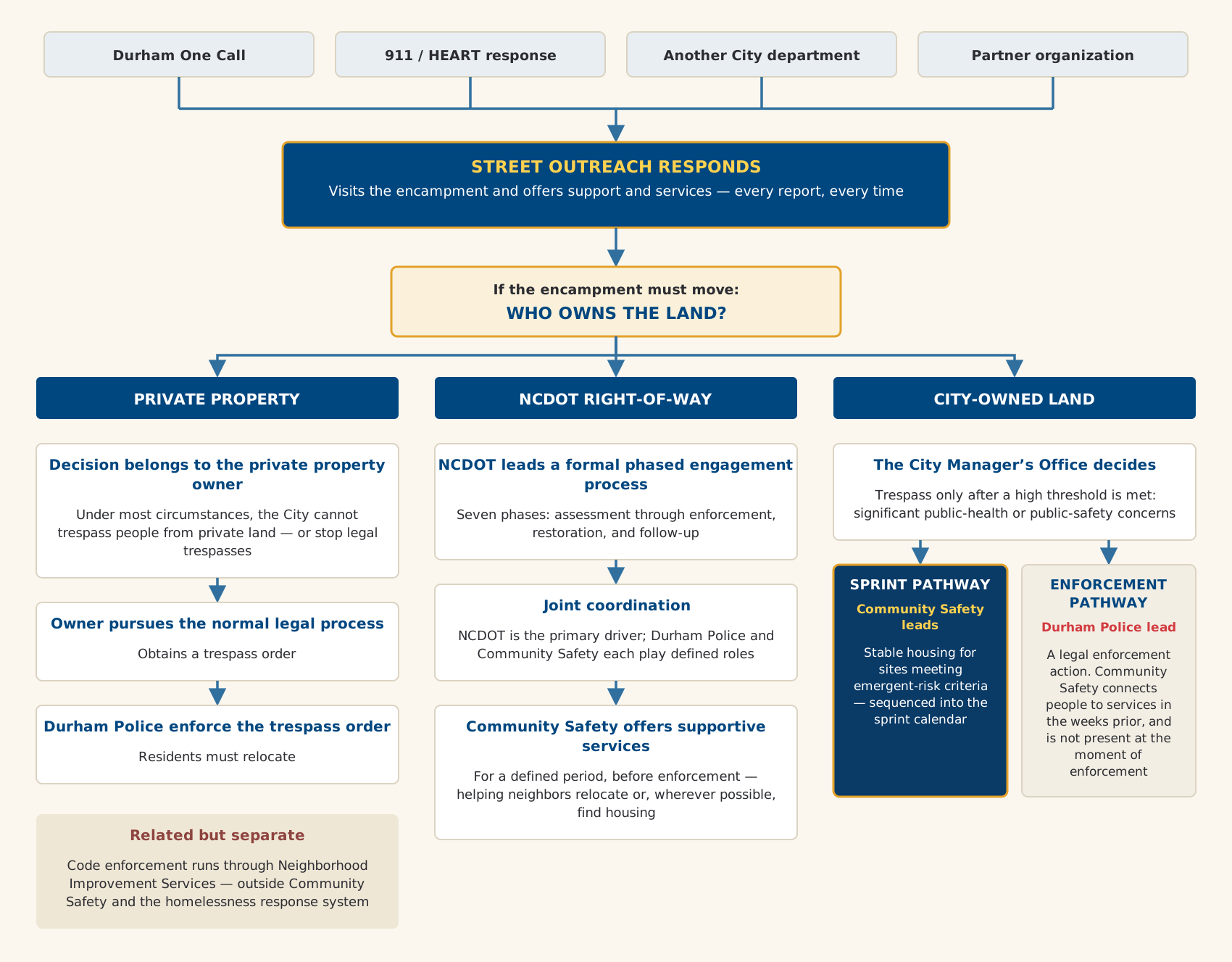
Reports of encampments reach the Community Safety Department through several doors: Durham One Call, another City department, a partnering organization, or our own 911 response through HEART. Whatever the door, the first step is the same. Street outreach visits the encampment and offers support and services to the people living there. That engagement does not depend on what happens to the site — it continues before, during, and after every pathway described below.
When an encampment can no longer remain, there are fundamentally three pathways, and each is determined by land ownership. Roles change with the pathway, so it matters to be precise about which one is in play.
The three pathways
The flowchart below follows a report from the moment it arrives at Community Safety to the point an encampment is resolved. Every path opens the same way — a report reaches Community Safety, and street outreach responds with support and services. The path branches only if an encampment can no longer remain, and a single question sets the branch: who owns the land. The three columns — private property, NCDOT right-of-way, and City-owned land — are the three pathways described in the sections that follow, each with its own decision-maker, point agency, and role for Community Safety.
Pathway 1 · Private property
On private land, the decision belongs to the property owner. Under most circumstances, the City cannot trespass people from private land — or stop legal trespasses from private land. Both are the owner’s call.
An owner who wants an encampment moved follows the normal legal process: they obtain a trespass order, the Durham Police Department comes out, and the people living there are trespassed and must relocate. Community Safety’s street outreach continues to offer services to the people affected, but the enforcement itself is a private legal action, not a Community Safety operation.
Related, but separate
Code-enforcement concerns on private property — conditions, debris, structures — run through Neighborhood Improvement Services. That pathway is not controlled by the Community Safety Department or the homelessness response system.
Pathway 2 · NCDOT right-of-way
On land owned by the North Carolina Department of Transportation — most commonly highway right-of-way — NCDOT is the primary driver of a phased engagement process, a formalized seven-phase sequence NCDOT has set out in writing. Durham Police and Community Safety each play defined roles within it. Community Safety’s role is to offer supportive services for a period of time before any enforcement — helping people move somewhere else or, wherever possible, into housing.
| Phase | What happens |
|---|---|
| I · Assessment | Survey and documentation of the area; property-owner authorization. Ongoing throughout. |
| II · Needs | Needs at the site are recognized and resources to meet them are identified. |
| III · Planning | Operations finalized with command structures and legal; partners engaged — healthcare, behavioral health, faith institutions. |
| IV · Engagement | Meet, inform, and offer services. Engagement and uptake shape when an end date is set. No fixed duration. |
| V · Final notice | Law enforcement returns with one last opportunity to vacate. Most residents have already relocated by this point. |
| VI · Restoration | Site restoration and posting of signage by the landowner. |
| VII · Follow-up | Maintenance, re-assessment, and correction as needed. |
Pathway 3 · City-owned land
On City-owned land, the decision as to whether an encampment can no longer remain belongs to the City Manager’s Office. The City Manager’s Office typically issues a trespass only after a high threshold is met — significant public-health or public-safety concerns at the site. From there, the response follows one of two tracks.
Track A · The sprint pathway, Community Safety leads
Durham’s housing sprint process can take in encampments that present those public-health or public-safety concerns — sites designated under the emergent risk criteria in the sprint Policies and Procedures — provide the people living there with interim housing, and then move them into stable housing. When the sprint process is in use, the Community Safety Department is the lead.
The sprint process is sequenced: sprints run as scheduled moments across the fiscal year, which means not every encampment can be taken into a sprint immediately. Some encampments on City property may be resolved through enforcement without entering the sprint process at all.
Track B · The enforcement pathway, Durham Police leads
When the sprint process is not being used, the action is a legal enforcement action, and Durham Police leads it. These are two different types of processes, and the distinction matters for who is on the ground and when.
Where Community Safety is during enforcement
Even when police are engaged or leading, the Community Safety Department is active in the weeks prior, working to connect people at the site to services and other options. Street Outreach will not be present at the moment of an enforcement action. Street Outreach is a service relationship, not an enforcement role — and keeping the two separate is important to both.
The pathways, side by side
| Pathway | Who decides | Who leads | Community Safety’s role |
|---|---|---|---|
| Private property | The property owner | DPD, per trespass order | Outreach and services to those affected |
| NCDOT right-of-way | NCDOT | NCDOT, with DPD and DCSD | Supportive services before enforcement |
| City land · sprint | City Manager’s Office | Community Safety | Outreach, services and stable housing through sprints |
| City land · enforcement | City Manager’s Office | DPD | Services in the weeks prior; not present at the moment of enforcement |
The bottom line
One front door — street outreach — and three pathways set by land ownership. Whoever leads, our commitment holds: people living in encampments are offered support and services first, and the goal, wherever the pathway allows, is housing.